
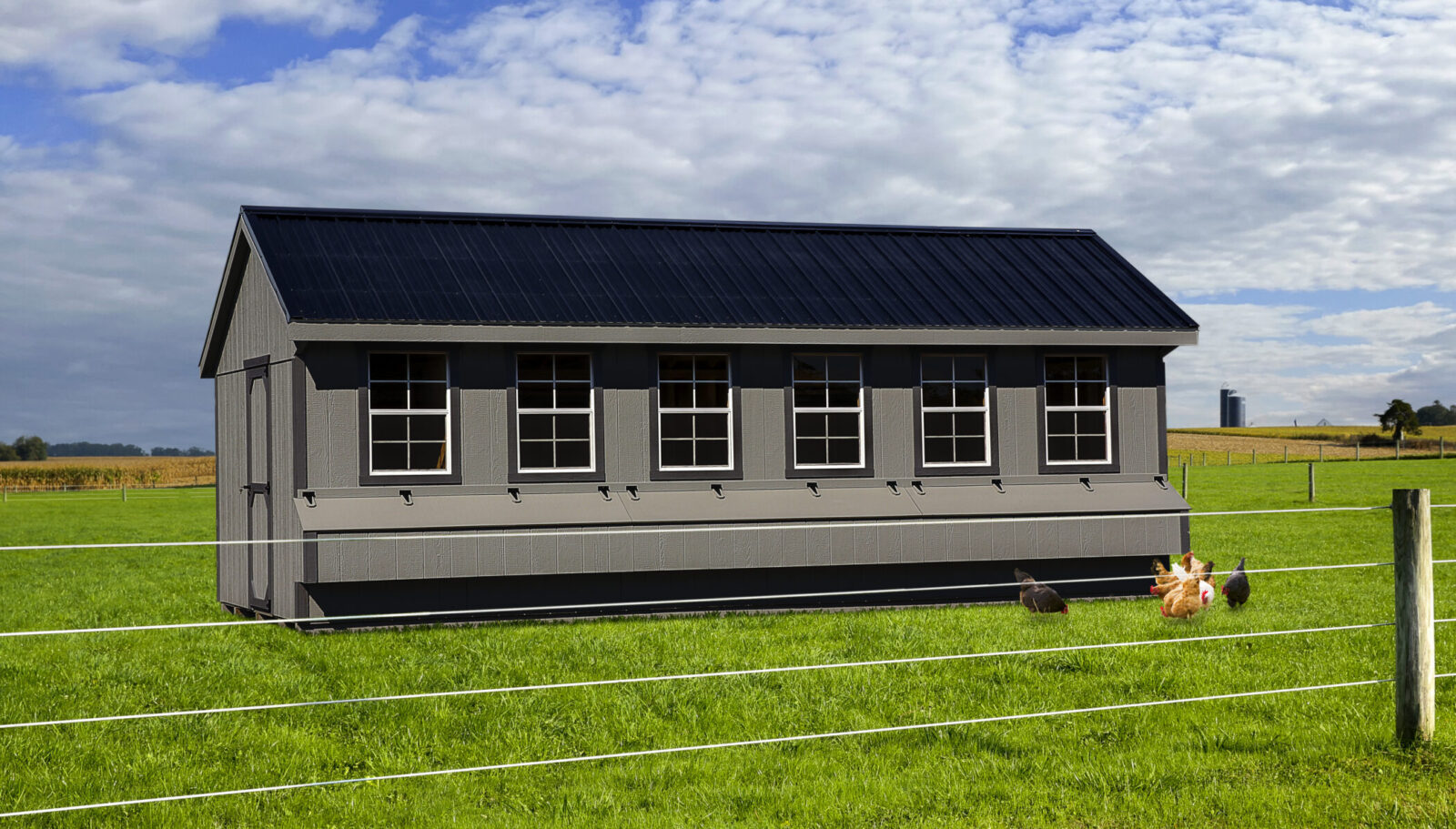
A lot of chicken coops look decent in a product photo. The one you actually end up with often tells a different story. Before you commit to any coop — ours or anyone else's — here are the five features that actually matter for your birds' health and your sanity.
1. Ventilation (The Most Overlooked Feature)
Chickens produce a lot of moisture through respiration, and their manure produces ammonia. Both of these need somewhere to go. A coop with poor ventilation gets hot, humid, and ammonia-rich — which is a respiratory illness waiting to happen and makes summer egg production drop significantly.
What good ventilation looks like:
- Vents near the roofline (hot air rises — vents at the top allow it to escape)
- Adjustable openings so you can control airflow in cold weather without closing everything off
- Windows positioned for cross-ventilation — airflow from one side to the other, not just one opening
- Hardware cloth (not solid doors) on at least some openings so you can leave them open even when predators are active
For Central Texas specifically, ventilation is more important than insulation. Our winters are mild; our summers are brutal. Size your ventilation for August, not January.
2. Predator Protection That's Actually Serious
"Predator resistant" is a marketing term. A determined raccoon, a large dog, or a family of coyotes will get into any enclosure that isn't properly built. The standard of protection matters.
What to look for:
- Hardware cloth, not chicken wire — chicken wire is designed to keep chickens in, not predators out. It can be torn by hand and chewed through by raccoons. Hardware cloth is welded, not woven, and resists these threats
- Gauge matters — 1/2" hardware cloth in 14–16 gauge is the appropriate spec for a permanent installation
- Latches that require two movements to open — raccoons have excellent fine motor skills and can open simple sliding latches. A two-step or carabiner latch is much more secure
- No gaps in the structure — anywhere a predator's paw can fit, it will explore
All the coops we carry use heavy-gauge galvanized hardware cloth on every opening. It's one of the reasons these coops cost more than kit coops — the material cost alone is significant.
3. Proper Nesting Boxes
Hens need a private, enclosed space to lay eggs. Without it, they'll lay wherever — and you'll spend time finding eggs in odd corners instead of collecting from the box.
What a good nesting box setup looks like:
- 1 box per 3–4 hens (minimum) — more is better; hens will wait in line for a favorite box
- Interior dimensions of approximately 12"×12"×12" — larger breeds need 14"×14"
- Located lower than the roost bars — if hens can sleep in the boxes, they will, and it creates a cleaning nightmare
- External access door is a nice feature — collect eggs from outside the coop without disturbing the interior
- Slightly dark and enclosed — hens feel more comfortable in a private box than an open one
Our coops include nesting boxes as standard, sized appropriately for the coop dimensions.
4. Easy Cleaning Access
Cleaning frequency depends on your flock size and management style, but every coop needs to be cleaned. A coop designed with cleaning in mind makes this a 20-minute job instead of a miserable afternoon.
Key features:
- Walk-in height or a large access door — being able to stand up inside (or at least get both shoulders in) makes cleaning with a shovel practical
- Droppings board under the roost — chickens do most of their dropping at night while roosting. A removable droppings board concentrates the mess and makes daily spot cleaning quick
- Smooth floor surface — bare wood floors absorb moisture; painted or sealed floors are easier to clean and more moisture-resistant
- Accessible corners — square corners accumulate debris; rounded or chamfered corners are easier to clear
5. Weather Resistance for Your Climate
A coop that handles Connecticut winters isn't automatically right for Central Texas, and vice versa. In our climate, the priorities are:
Heat management: Covered above under ventilation. Shade placement, proper ventilation sizing, and a good roof overhang for blocking afternoon sun all matter more in Texas than wall insulation.
Moisture resistance: We get significant rain in spring, and the humidity during warm months is real. Your coop's siding, floor, and roofing all need to handle moisture without warping, swelling, or rotting. This is where LP SmartSide® engineered siding earns its keep — it's specifically engineered for moisture resistance in ways that standard cedar or pine siding is not.
Wind: Central Texas gets strong thunderstorm winds. The structural integrity of the coop matters; flat-pack construction that relies entirely on screws isn't great in this regard. Look for a coop with solid framing that's mechanically connected, not just fastened together.
Roofing: A metal roof (standing seam or corrugated) is our preference for longevity and weather resistance. Asphalt shingles work too, but require more maintenance over time.
The Bottom Line
A quality coop has all five of these covered. A cheap kit coop typically has at best two or three, and usually the wrong two or three. When you're evaluating any coop — including ours — these are the questions to ask.
Browse our full coop lineup to see how our Amish-built coops handle each of these. Or contact us with questions about specific features and what's right for your situation.


