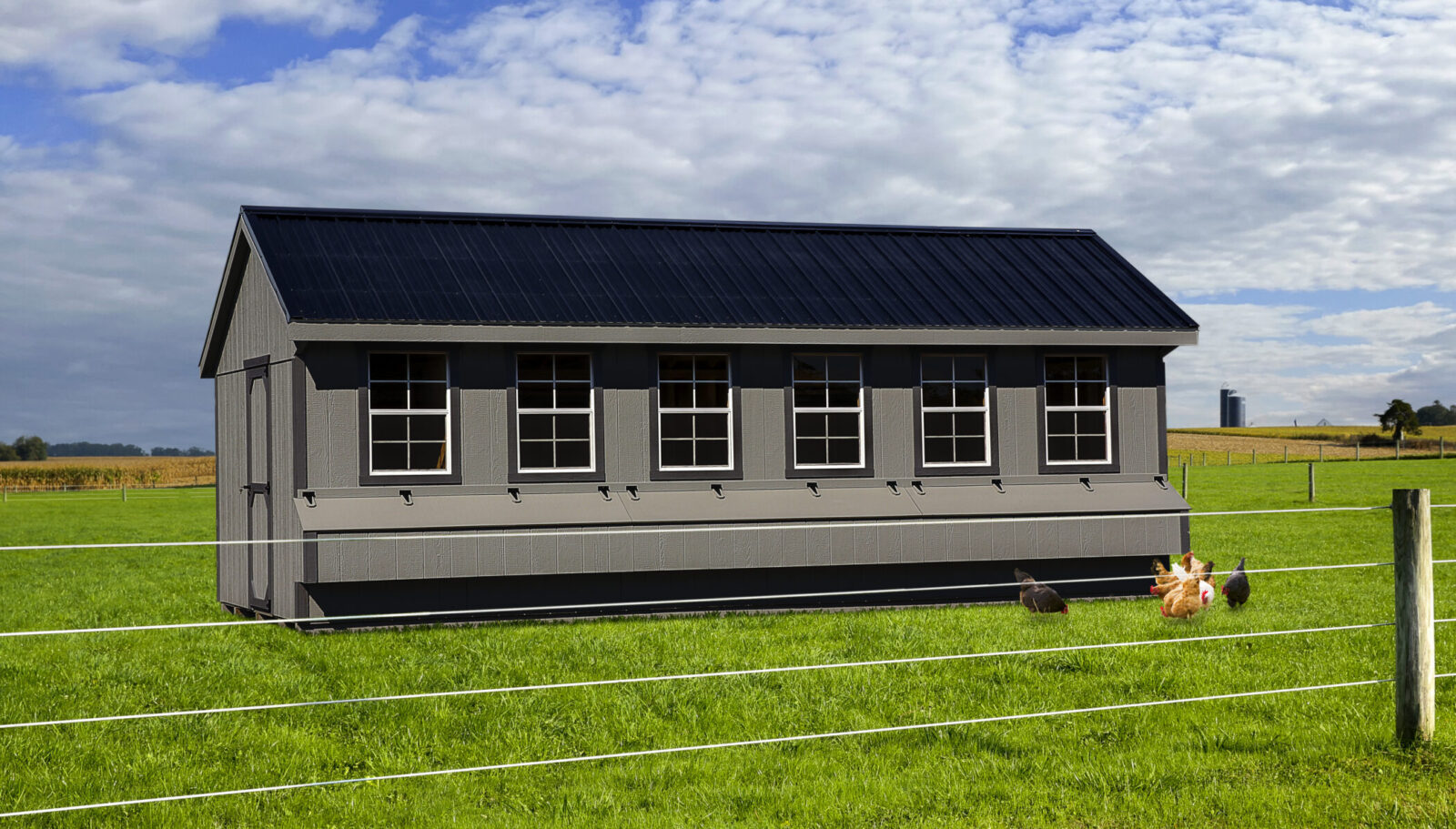

Walk into any Tractor Supply or Farm & Fleet and you'll find a chicken coop kit for $300–$600. Order one online and it ships in a flat box. A week after it arrives, you've spent a weekend assembling it from particle board panels and stamped metal hardware.
Three years later, the floor is rotting. The door doesn't latch right anymore. One good Texas windstorm took a panel loose and you've been meaning to fix it.
This is the experience that sends most serious backyard chicken keepers looking for something better. Here's an honest breakdown of what the difference actually is.
The Materials Gap
Store-bought coop kits are built around one goal: a price point. That means:
Standard siding materials that absorb moisture, warp in heat, and start to degrade within a few seasons of outdoor exposure in a humid climate like Central Texas.
Thin hardware cloth or chicken wire that's fine against casual predators but won't stop a determined raccoon or large dog. Raccoons are problem-solvers; thin wire is not a meaningful barrier for them.
Stamped and plated hardware — hinges, latches, and clasps that are plated rather than galvanized. Plating holds up in a jewelry box. Galvanizing is what holds up in a chicken coop in Texas humidity.
The Amish-built coops we carry use:
- LP SmartSide® engineered siding — treated for moisture and impact resistance, backed by a 5/50 year warranty from the manufacturer
- Heavy-gauge galvanized hardware cloth on all openings — this is the same material used in professional agricultural fencing
- Solid timber framing — no OSB, no particle board, no finger-jointed lumber
- Galvanized metal hardware throughout — hinges, latches, clasps
Construction Quality
A flat-pack kit is designed to be assembled by a homeowner with basic tools. That means the joinery is simplified to a point where the structure has no real mechanical integrity beyond the fasteners holding the panels together. When fasteners loosen or degrade — and they will — the structure follows.
Amish-built coops use traditional woodworking joinery: rabbeted corners, properly fitted door frames, structural framing that ties the structure together mechanically, not just with screws. The difference is immediately apparent when you see one in person — there's no wobble, no flex, no give anywhere in the structure.
The other thing you notice is the fit and finish. Doors that actually close flush and latch cleanly. Windows that open and close properly. Hardware that's installed straight.
What This Looks Like Over Time
A $400 kit coop has a realistic useful life of 3–5 years in Central Texas conditions before significant deterioration. At that point, you're either replacing it or making repairs.
A properly built and maintained Amish coop — the kind we sell — is realistically a 15–25 year structure. The LP SmartSide® siding doesn't rot. The galvanized hardware doesn't rust through. The framing stays tight. Annual cleaning, a fresh coat of exterior paint or stain every few years, and you're done.
The Real Cost Comparison
A $400 kit replaced every 4 years over 20 years = $2,000, plus your time and the disruption to your flock.
A $2,000 Amish-built coop lasting 20+ years = $2,000, installed, done.
The math isn't subtle. And that's before accounting for the fact that the kit coop likely provides less space, worse ventilation, and more predator risk than a properly built structure.
What We're Selling You
We're not here to oversell. If you have 2 chickens and a $400 budget and you understand what you're getting, a kit coop might work fine for a few years. But if you're setting up a real flock that you intend to keep for the long term, the Amish-built option is the right choice — and it's a lot closer in price than you might think when you factor in the full lifecycle.
Browse our coop styles to see what's available. If you're not sure what's right for your property and flock size, reach out and we'll help you figure it out.